
Study report · #WellbeingMatters · October 2026

Working women in Poland are exhausted

How women who run businesses, lead teams and work as employees really feel. Results of a survey of 504 working women.

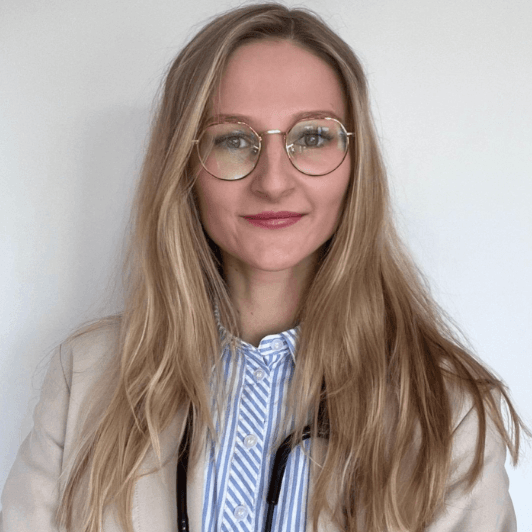
  • Katarzyna Woźniak, MDmedical director
  • Natalia Kusyn, MDpsychiatry resident

1. Results

What the results showed

Share of the women surveyed whose questionnaire pointed to a problem.

3 in 4

have symptoms of insomnia

7 in 10

have reduced well-being

6 in 10

have symptoms that may indicate an anxiety disorder

Most have insomnia, almost no one has a diagnosis
  • Have symptoms of insomnia

    about75%
  • Report a diagnosed sleep disorder

    about4%
ADHD more often among women who run businesses
  • Run a business

    14.5%
  • Employees without a managerial role

    3.8%

Self-reported diagnoses.

2. Job roles

We expected founders to be the most exhausted. They were not.

They carry all the business risk and most often work without limits on hours. Yet exhaustion, insomnia and low mood look similar in all groups. The differences between them are not statistically significant. Your job role does not protect you.

Workload: big differences

Work 50 hours a week or more
  • founders39%
  • managers17%
  • employees11%

Axis scale: 0–50%.

Well-being: similar in all groups

Share of all women surveyed
  • experience exhaustion9 in 10
  • marked insomnia54%
  • weak support from people close to them1 in 2
  • score suggesting possible depression1 in 3

The differences between founders, managers and employees are not statistically significant.

Different roles, different stressors

The same things stress everyone most: no time to rest and workload. The differences are in the details: founders worry more often about uncertainty and finances, managers and employees more often about conflicts at work.

Founders

Most common sources of stress

  • Workload and working hours71%
  • Lack of time to recover and rest64%
  • Financial pressure in personal life64%

Sets this group apart

  • Uncertainty about the future61%

employees: 40%

Managers

Most common sources of stress

  • Lack of time to recover and rest65%
  • Workload and working hours60%
  • Being caught between a rock and a hard place58%

Sets this group apart

  • No control over tasks36%

founders: 23%

Employees

Most common sources of stress

  • Lack of time to recover and rest58%
  • Workload and working hours55%
  • Financial pressure in personal life50%

Sets this group apart

  • Conflicts at work31%

founders: 19%

Share of women who rated the factor as a considerable or very strong source of stress in the last 3 months (3–4 on a 0–4 scale).

The main barrier to getting help is cost

Concern about the company's image barely matters.

Founders seek help most often

Especially those who run their business on their own.

3. What about men?

Why the study is about women

517 people completed the survey, including only 13 men. That is too few to describe them reliably. But fewer men in the data does not mean they are healthier.

We are planning a separate study of men, carried out together with employers.

73%
of people treated for depression under the Polish public health system (NFZ) are women. Men see a doctor later, often with atypical symptoms: irritability, alcohol, escaping into work.
83%
of suicides in Poland in 2025 were men.

Sources: National Health Fund (NFZ), NFZ o zdrowiu. Depresja, 2020; Office of the Polish Ombudsman, meeting of the Expert Committee on Mental Health, 4 March 2025; Polish National Police Headquarters, suicide data for 2025.

4. Authors

Who prepared the study

Two doctors who see Zapytaj Lekarza patients every day.

Katarzyna Woźniak, MD

Katarzyna Woźniak, MD

Founder and medical director of Zapytaj Lekarza

A graduate of the Medical University of Lublin and a PhD student there. A member of the Polish Society for the Treatment of Obesity, certified in comprehensive obesity treatment. Since 2016 she has been educating people about health as “Mama i Stetoskop”.

Doctor's profile (in Polish) →
Natalia Kusyn, MD

Natalia Kusyn, MD

Doctor, psychiatry resident

A graduate of Wroclaw Medical University, now training in psychiatry. She focuses on prevention and on how lifestyle affects mental and physical health. A certified member of the Polish Society for the Study of Obesity and the Polish Society for the Treatment of Obesity, she has completed postgraduate studies in psychodietetics.

Doctor's profile (in Polish) →

The results were presented at an event held in partnership with OVHcloud.

5. What next

Many of these symptoms can be treated effectively

Insomnia, tension or exhaustion that last for weeks are a sign that it is worth talking to a specialist. You don't have to wait for it to pass on its own.

Early access · PLN 599

The Business Owner's Check-up

A complete health check-up for people who have no time for one. A doctor and a psychologist, tests chosen for you, a written report with an action plan and a care coordinator who books everything for you.

See the Check-up (in Polish)
Online

Consultation with a specialist

If you already know what you are dealing with. Zapytaj Lekarza psychologists, psychiatrists and psychotherapists see patients online, no travel needed.

Book an online consultation (in Polish)

If you are in crisis, call 800 70 2222, 24/7 and free of charge. In a life-threatening emergency, call 112.

6. About the study

Questions about the study

Who took part?
504 women: 83 founders, 101 managers and 320 employees. Mostly aged 25–44, with higher education, from all over Poland, working at least full time.
How was it carried out?
An anonymous online survey in July 2026. Validated questionnaires on well-being, anxiety, burnout and sleep, plus questions about stressors, diagnoses and seeking help.
Do the results apply to all women in Poland?
Not directly. Taking part was voluntary, so the results describe the women surveyed. They do, however, show a clear trend that is worth taking seriously.
Is a questionnaire score a diagnosis?
No. A questionnaire points to a possible problem, and a diagnosis is made by a doctor after talking to the patient. The diagnoses we mention, such as ADHD or sleep disorders, are self-reported.
How is exhaustion different from tiredness?
Tiredness goes away after rest. Exhaustion stays despite a weekend or a holiday and usually comes with poorer sleep, irritability and trouble concentrating.
I recognise these symptoms in myself. What can I do?
Talk to a specialist: a doctor, a psychologist or a psychiatrist. Insomnia, anxiety and exhaustion respond well to treatment. At Zapytaj Lekarza you can book an online consultation, often within the next few days.
Want to know more?
If you would like more information about the study, or to talk about its results or the issues it covers, write to kontakt@zapytaj-lekarza.pl. We will help arrange a conversation with the authors.